Knee Pain When Bending Causes Warning Signs and Treatment in Sharjah
Knee pain when bending can come from the kneecap joint, meniscus, cartilage, tendons, ligaments, bursae or inflammation inside the knee. The movement...
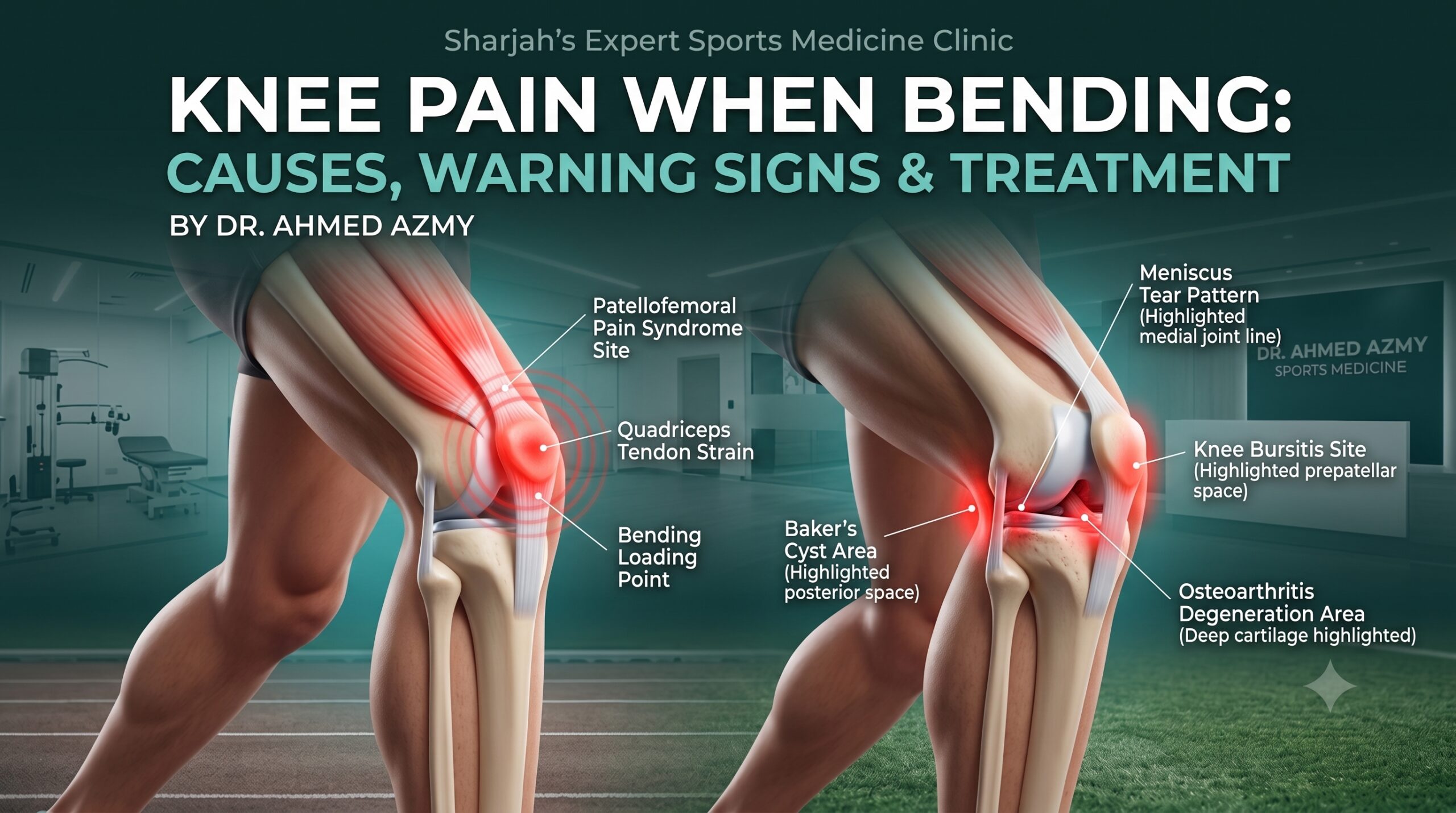
Knee pain when bending can come from the kneecap joint, meniscus, cartilage, tendons, ligaments, bursae or inflammation inside the knee. The movement that triggers pain provides a useful clue, but it does not identify one diagnosis by itself. Pain during stairs or squats is assessed differently from locking after a twist, a swollen kneecap after kneeling or stiffness after prolonged sitting.
Location, injury history, swelling, clicking, instability and the ability to fully bend and straighten the knee all matter. Severe trauma, a knee that is physically locked, inability to bear weight, visible deformity or a hot swollen joint with fever requires prompt medical assessment.
This guide explains the common causes, the symptom patterns that help distinguish them, how diagnosis is made and which treatments may be considered. The right plan depends on the painful structure and the demands of work, exercise and daily movement.
Why Does the Knee Hurt When It Bends
Bending changes the pressure across several parts of the knee. The kneecap glides in a groove at the end of the thighbone, the menisci distribute load between the thigh and shin bones, and the surrounding muscles and tendons control the movement. Deeper bending usually increases demand, so irritated tissue may hurt during squatting, kneeling, stairs or rising from a chair.
The pattern often seen with front-of-knee pain is described in the AAOS guide to patellofemoral pain syndrome: symptoms may become more noticeable with stairs, squats, running or prolonged sitting. However, joint-line pain, locking, trauma or substantial swelling can point to a different cause.
What Different Bending Movements Can Suggest
The task and the depth at which pain starts help organize the examination. The table is a clinical guide rather than a self-diagnosis tool.
| Painful movement | Common pain area | Possibilities considered |
|---|---|---|
| Stairs or a shallow squat | Front or around the kneecap | Patellofemoral pain, tendon irritation or cartilage-related pain |
| Deep squat | Joint line, front or back of the knee | Meniscus, cartilage, bursa or joint swelling |
| Kneeling | Over or below the kneecap | Prepatellar or infrapatellar bursitis and local tissue irritation |
| Bending after sitting | Front of the knee with stiffness or clicking | Patellofemoral pain or arthritis-related stiffness |
| Bending after a twist | Inner or outer joint line | Meniscus or ligament injury |
Common Causes of Knee Pain When Bending

Bending places dynamic compressive and shear loads across the joint, making mechanical irritation more noticeable. Identifying whether the pain stems from the patellofemoral tracking mechanism, shock-absorbing menisci, stabilizing ligaments, or surrounding tendons is essential for an accurate diagnosis and targeted recovery plan.
Patellofemoral Pain
Patellofemoral pain is felt around or behind the kneecap. It often becomes more noticeable during stairs, squats, running, jumping or after sitting with the knee bent for a long time. Training load, hip and thigh strength, movement control and the way the kneecap handles pressure can all contribute. The pain is commonly activity-related, although clicking or a grinding sensation may also occur.
Meniscus Injury
The menisci are cartilage structures that distribute load and help stabilize the knee. A tear may follow a twist or develop gradually with age-related changes. Pain is often concentrated along the inner or outer joint line and may worsen with deep bending, pivoting or squatting. Swelling, catching, painful clicking, loss of full extension or true locking increases concern for a mechanical problem.
The AAOS overview of meniscus tears notes that symptoms may include pain, stiffness, swelling, catching or locking. An examination is still needed because these features can overlap with other knee conditions.
For a closer look at tear patterns and treatment decisions, read the clinic guide to meniscus tear treatment.
Cartilage Irritation or Osteoarthritis
Cartilage changes can cause a deeper ache, stiffness, reduced motion and swelling. Symptoms may be worse after loading or when standing after rest. Osteoarthritis does not always produce severe pain, and an X-ray finding must be interpreted alongside the examination and the patient’s function. Treatment usually focuses on strength, movement, load management and symptom control before surgery is considered.
Persistent stiffness or recurrent swelling may also be explored in this guide to knee cartilage treatment without surgery.
Knee Bursitis
Bursitis causes focal tenderness or a superficial swelling near the knee. Repeated kneeling can irritate the bursa over the kneecap, while pain on the inner side below the joint may involve the pes anserine bursa. Bending can compress the inflamed area. A hot red swelling with fever, chills, a wound or drainage needs prompt assessment for infection.
Patellar or Quadriceps Tendon Pain
The patellar tendon lies below the kneecap and the quadriceps tendon attaches above it. Running, jumping or a rapid increase in training can overload either tendon. Pain is usually localized above or below the kneecap and may be reproduced by stairs, squats, jumping or resisted knee extension. A sudden pop, visible gap or inability to actively straighten the knee can indicate a major tendon injury and needs urgent assessment.
Ligament or Traumatic Injury
A fall, collision, pivot or hyperextension can injure a ligament and other internal structures. Swelling, instability, difficulty bearing weight or a sense that the knee gives way makes a simple overuse explanation less likely. Multiple structures may be injured in one event, so the entire knee should be examined rather than focusing only on the bending pain.
Where Is the Pain Located
Before an appointment, notice where the pain is most concentrated. Front-of-knee pain often leads the examination toward the kneecap or tendons. Inner or outer joint-line pain raises different possibilities, including a meniscus injury. Pain behind the knee may come from a Baker’s cyst, muscle-tendon strain or joint swelling. Diffuse pain can accompany arthritis, inflammation or a larger effusion.
Location guides the assessment but cannot confirm the diagnosis because pain can spread and more than one condition can be present. A Baker’s cyst, for example, may be associated with arthritis or a meniscus problem rather than being the only issue.
If discomfort is mainly posterior, the dedicated article on back of knee pain explains the common causes and urgent calf symptoms in more detail.
Knee Pain When Squatting
Squatting substantially increases joint flexion angles, placing peaked compressive and shear forces across the patellofemoral joint, menisci, articular cartilage, and surrounding stabilizing muscles.
-
Front-of-Knee Discomfort: Diffuse aching around or behind the kneecap during squats usually reflects patellofemoral load intolerance or poor quad-to-hip load distribution rather than acute tissue damage.
-
Joint-Line Catching or Sharp Pain: Pain localized along the inner or outer joint margins—especially following a twisting movement or deep knee bend—raises clinical suspicion for a meniscus tear.
-
Superficial Swelling & Tenderness: Visible puffiness or warmth directly overlying the kneecap points toward localized prepatellar bursitis or tendon irritation rather than an intra-articular tear.
-
Temporary Range Modification: Reducing squat depth (e.g., box squats to a comfortable angle) manages acute symptoms without requiring complete cessation of lower-body movement.
-
Graded Rehabilitation: Once acute trauma is excluded, progressively restoring range, quadriceps strength, and hip control rebuilds squat tolerance without repeatedly forcing the joint into painful deep flexion.
Knee Pain on Stairs
Stairs require the thigh muscles to control the body while pressure increases at the kneecap. Pain going down may be particularly noticeable when movement control or patellofemoral load is a factor. Pain going up can also involve the quadriceps or patellar tendon. The clinician considers the exact area, swelling, weakness and whether symptoms appear during push-off or controlled lowering.
Knee Pain After Sitting
Some people develop an ache around the kneecap after the knee has remained bent during work, driving or a flight. The discomfort may ease after a few steps. This pattern is often associated with patellofemoral pain, but stiffness after rest can also occur with arthritis. A history of locking, major swelling or trauma changes the assessment.
Symptoms That Help Distinguish the Cause
| Associated symptom | Why it matters | Suggested action |
|---|---|---|
| Swelling | Timing and location may distinguish trauma, irritation and inflammation | Assessment if rapid, large, hot or persistent |
| Painful catching or locking | Can suggest a mechanical problem inside the joint | Timely orthopedic review |
| Giving way | May reflect instability, pain inhibition or poor control | Avoid risky activity and arrange assessment |
| Stiffness after rest | Often accompanies kneecap or arthritis-related problems | Review if persistent or limiting |
| Focal superficial lump | May indicate bursitis or another local swelling | Check skin heat, redness and wounds |
| Numbness or radiating pain | Suggests nerve or referred causes should be considered | Clinical assessment |
When Is Knee Pain When Bending Urgent
While many knee conditions improve with conservative care and load adjustment, specific “red flag” symptoms signal serious joint compromise, acute trauma, infection, or neurovascular injury requiring emergency medical evaluation rather than routine home management.
-
Signs of Joint Infection (Septic Arthritis): A knee that is hot to the touch, visibly red, rapidly swollen, and accompanied by fever, chills, or an open draining wound requires immediate clinical intervention.
-
Acute Structural Trauma & Deformity: Visible joint misalignment, obvious bony step-offs, an abnormal kneecap position, or an immediate inability to bear weight after a fall or high-energy impact suggests a fracture or acute ligament dislocation.
-
True Mechanical Locking: A joint that is physically stuck, blocked, or unable to fully straighten (often due to a displaced bucket-handle meniscus tear or loose body) requires prompt orthopedic review—never forcibly bend or manipulate a locked knee.
-
Neurovascular Compromise: A foot or lower leg that becomes cold, pale, bluish, or develops progressive numbness, tingling, or sudden muscle drop points to vascular or peripheral nerve distress.
-
Rapid, Intractable Pain: Pain that escalates aggressively within hours without relief from rest, or a joint that develops massive fluid swelling (tense effusion) within an hour of injury, demands timely hospital assessment.
How Knee Pain When Bending Is Diagnosed
A precise diagnosis determines which anatomical structure, such as the patellofemoral joint, meniscus, cartilage, or tendon, is failing to tolerate load during flexion, ensuring treatment directly targets the underlying mechanical cause rather than just masking symptoms.
-
Detailed Clinical History: The specialist evaluates when pain occurs (e.g., stairs, deep squats, prolonged sitting), whether symptoms followed sudden trauma or a training spike, and checks for mechanical red flags like clicking, true locking, swelling, or sensations of giving way.
-
Hands-On Physical Examination: Evaluates resting gait, active and passive range of motion, joint effusion (fluid swelling), patellar tracking and glide, localized joint-line tenderness, and distal neurovascular circulation.
-
Controlled Functional Testing: When safe, functional movements such as a shallow squat or step-down are assessed to observe dynamic knee alignment, quadriceps control, and hip stability under load without provoking severe pain.
-
Selective Diagnostic Imaging: Advanced tests are tailored to answer specific clinical questions rather than ordered as a default for every patient:
-
X-rays: Examine bone alignment, joint space narrowing from cartilage wear (osteoarthritis), patellar tilt, and bone spurs.
-
Ultrasound: Delivers dynamic, non-invasive assessment of superficial tissues, including quadriceps and patellar tendon integrity, bursal fluid accumulation, and Baker’s cysts.
-
MRI: Reserved for suspected intra-articular soft-tissue disruption, such as meniscus tears, cruciate/collateral ligament sprains, or deep chondral cartilage defects.
-
Treatment for Knee Pain When Bending
Treatment depends on the diagnosis. Many stable, non-emergency mechanical conditions begin with conservative care. A locked knee, unstable injury, infection or confirmed structural problem may follow a different pathway.
Modify the Painful Load
Temporarily reduce the depth, impact, twisting or stair volume that clearly worsens symptoms. Keep comfortable movement when possible rather than stopping all activity for a long period. Load can be rebuilt in stages as pain, swelling and control improve.
Physiotherapy
A rehabilitation plan may address hip and knee strength, mobility, balance and movement control. Exercises should match the diagnosis and current tolerance. A person with kneecap-related pain may require a different progression from someone recovering from a meniscus or ligament injury. Response later that day and the following morning helps guide progression.
Medication and Symptom Relief
Pain-relieving or anti-inflammatory medication may be considered when appropriate, but suitability varies. Kidney disease, stomach ulcers, cardiovascular conditions, pregnancy, blood-thinning medication and other medicines can change the risk. Follow advice from a clinician or pharmacist and do not use pain relief to push through a locked, unstable or acutely swollen knee.
Injections Aspiration or Surgery
An injection or aspiration is used only for a defined diagnosis and selected cases. A swollen bursa or joint may require fluid testing if infection or crystals are suspected. Arthroscopy or another operation is not a default treatment for bending pain; it may be discussed for selected mechanical, unstable or persistent structural problems after examination and appropriate imaging.
The clinic’s knee treatment and arthroscopy pathway provides more information about diagnosis-led conservative and surgical options.
Safe Self Care and What to Avoid
Managing knee discomfort at home requires protecting irritated tissues from aggravating mechanical loads while keeping the joint gently active to support circulation and mobility.
- Reduce the movement depth or activity volume that clearly triggers pain.
- Keep comfortable walking and gentle movement if there was no major injury or warning sign.
- Use a wrapped cold pack briefly if it feels comfortable; do not place ice directly on the skin.
- Avoid repeatedly forcing the knee into the most painful position to test it.
- Do not resume full training because symptoms improved for only one day.
- Seek assessment if pain persists, recurs or is associated with swelling, locking or instability.
Recovery and Return to Activity
Because knee pain during bending stems from diverse structural causes—from mild patellofemoral overload to complex meniscus or cartilage pathology—rehabilitation timelines must be guided by objective functional milestones rather than rigid calendar dates.
-
Milestone-Based Functional Markers: Progression relies on achieving key clinical benchmarks, including minimal to no swelling, pain-free daily walking, symmetrical bending (flexion) and straightening (extension), and restoring quad-to-hamstring strength without post-activity flare-ups.
-
Graded Movement Loading: Returning to high-demand tasks like squats, running, or cutting maneuvers begins with controlled, low-load exercises and gradually increases in depth, speed, and multidirectional impact as tissue tolerance improves.
-
Monitoring Post-Load Response: Pain that alters movement biomechanics, provokes noticeable joint swelling, or worsens the following morning signals that tissue capacity has been exceeded and training volume must be adjusted.
-
Injury Prevention Principles: Review our clinic’s practical guide on preventing sports injuries to ensure a structured, durable return to exercise and sport.
When to See an Orthopedic Specialist in Sharjah
Arrange an orthopedic assessment when knee pain when bending persists, repeatedly returns, limits stairs or squatting, follows an injury or occurs with swelling, locking or giving way. Earlier review is sensible when work or sport requires repeated deep bending and symptoms are affecting movement quality.
For a diagnosis-led knee assessment in Sharjah, contact Dr. Ahmed Azmy Clinic to arrange an appointment. Use urgent services instead of a routine booking when severe trauma, infection or circulation symptoms are possible.
Conclusion
Knee pain when bending is a symptom shared by several conditions, so treatment should be based on the complete pattern rather than the movement alone. Notice the pain location, swelling, injury history and mechanical symptoms, reduce clearly aggravating loads and arrange an assessment when pain persists or function is limited. Urgent warning signs should not wait for a routine appointment.
Medical Disclaimer
This article is for general education only. It does not diagnose an individual condition or replace care from a qualified healthcare professional. Treatment and return-to-activity decisions must be individualized. Seek urgent medical help for severe or rapidly worsening symptoms, suspected infection, major trauma, circulation changes, chest pain or shortness of breath.
Book an appointment now with Dr Ahmed Azmy in Sharjah.