Groin Pain in Athletes: Causes, Diagnosis and Treatment
Groin pain in athletes is commonly linked to the adductor muscles, hip flexors, hip joint, lower abdominal wall, or pubic region. It...

Groin pain in athletes is commonly linked to the adductor muscles, hip flexors, hip joint, lower abdominal wall, or pubic region. It may begin suddenly during a kick, sprint, split, or change of direction, or build gradually as training load increases. Because several structures sit close together and more than one problem can exist at the same time, “groin strain” should not be used as an automatic diagnosis for every painful groin.
A mild muscle injury may improve with activity modification and progressive rehabilitation. Persistent pain, a visible groin lump, inability to bear weight, testicular pain, abdominal symptoms, fever, or pain after significant trauma needs medical assessment. Athletes in Sharjah and across the UAE can book an orthopedic consultation with Dr. Ahmed Azmy for a structured diagnosis and return-to-sport plan.
What Is Groin Pain in Athletes?
Groin pain in athletes refers to discomfort, tenderness, or functional limitation occurring where the lower abdomen meets the inner thigh and pelvis. It represents one of the most challenging common sports injuries seen in multi-directional sports—such as football, rugby, padel, and hockey—that require repetitive high-speed kicking, sprinting, and sharp changes of direction.
-
Multi-Tissue Complexity: The groin functions as a mechanical junction where abdominal muscles, adductor tendons, and hip joint stabilizers converge; pain can originate from any of these overlapping structures.
-
Acute vs. Overuse Onset: Symptoms may arise suddenly from an acute adductor muscle pull during a rapid cut, or develop insidiously as a chronic tendon overload from cumulative athletic demand.
-
Diagnostic Distinction: Groin pain is not a single diagnosis, but a clinical symptom that encompasses adductor tendinopathy, pubic-related stress, abdominal wall weakness (athletic pubalgia), or underlying hip joint mechanics.
Where Is the Groin and Why Can It Hurt?
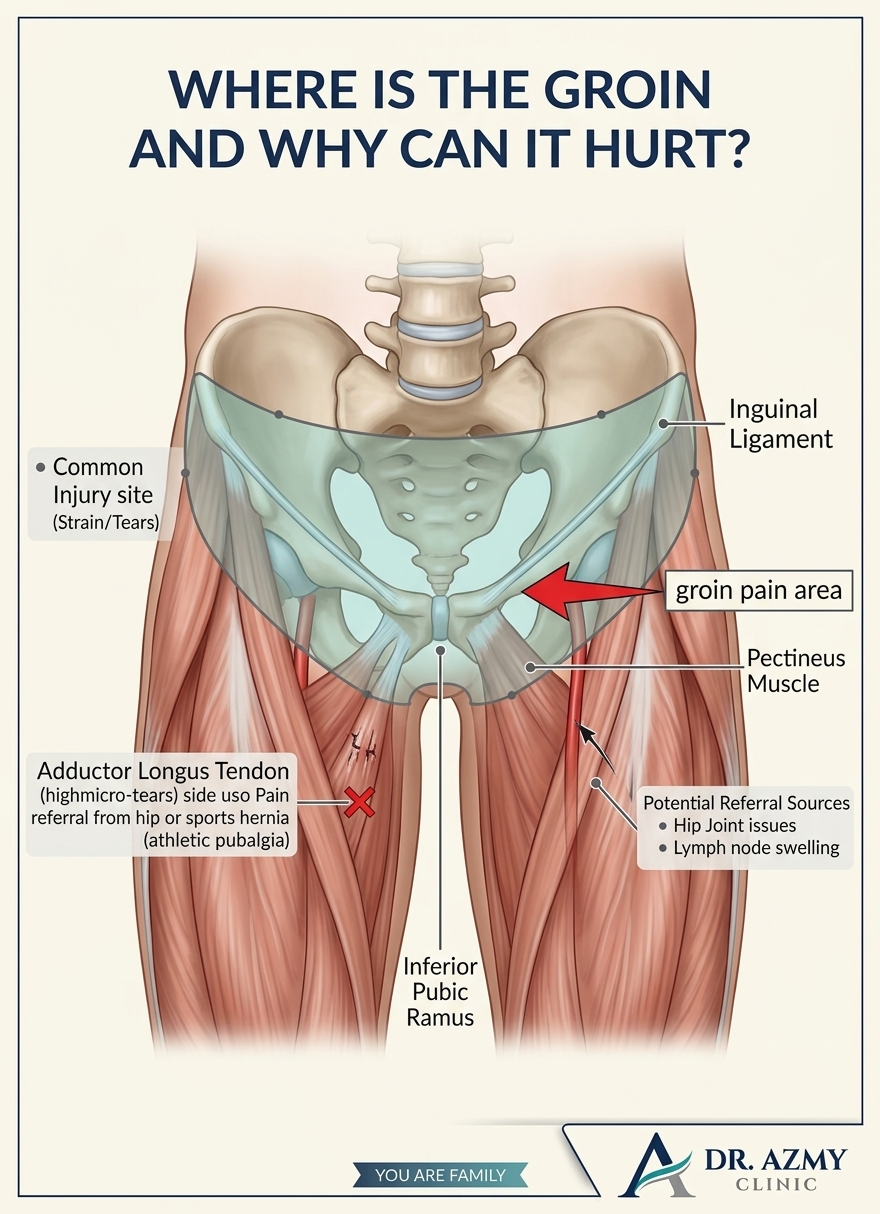
The groin is the junction between the lower abdomen and the upper inner thigh. The adductor muscles pull the leg toward the body and help control cutting, kicking, landing, and rapid direction changes. Nearby structures include the hip flexors, abdominal muscles, pubic symphysis, hip joint, nerves, and the inguinal canal. Pain from the lower back, abdomen, urinary system, or reproductive organs can also be felt in this region.
This overlap explains why the exact site and behaviour of pain matter. Pain reproduced by squeezing the knees together may point toward an adductor-related problem, while deep pain with hip rotation may raise concern about the hip joint. Pain with coughing or straining may suggest an inguinal or abdominal-wall source, but no single symptom confirms the diagnosis by itself.
Common Causes of Groin Pain in Athletes
Sports clinicians classify athletic groin pain by the structures most likely to be involved rather than treating it as one condition. The same athlete may have features from more than one category.
| Possible source | Typical clues | Important distinction |
| Adductor-related pain | Tenderness on the inner thigh and pain with resisted adduction, kicking or changing direction | May be an acute strain or a longer-lasting load-related problem |
| Iliopsoas or hip-flexor pain | Pain at the front of the groin with resisted hip flexion or stretching the hip | Can overlap with hip-joint symptoms |
| Inguinal-related pain | Discomfort near the inguinal canal, sometimes worse with abdominal resistance, coughing or straining | A true inguinal hernia must be considered, especially if a lump is present |
| Pubic-related pain | Local tenderness over the pubic symphysis and pain with running, kicking or directional change | Often develops gradually and may coexist with adductor pain |
| Hip-related pain | Deep groin pain, stiffness, clicking or reduced rotation | May involve impingement, labral injury, cartilage or other joint pathology |
| Other causes | Referred pain, stress injury, nerve irritation, abdominal, urinary or reproductive conditions | Requires a wider medical assessment when symptoms are atypical |
Adductor Strain and Inner Thigh Pain
An adductor strain is one of the most recognisable sports-related causes. It can happen when the muscle is forced to contract while lengthening, as during a powerful kick, sudden side step, tackle, or slip. The athlete may feel a sharp pull in the inner thigh and may be unable to continue. Swelling or bruising can follow, although their absence does not rule out injury.
Gradual adductor pain behaves differently. It may start as stiffness during warm-up, ease temporarily, and return after training. Continuing to increase kicking, sprinting, or cutting volume without restoring strength and load tolerance can make the problem persistent.
Is a Sports Hernia a True Hernia?
The term “sports hernia” is often used for activity-related pain around the lower abdomen and groin, but it does not always describe a conventional hernia with a visible bulge. Athletic pubalgia or inguinal-related groin pain may involve injured or overloaded tissues around the abdominal wall and pubic attachment. A true inguinal or femoral hernia remains an important alternative diagnosis.
The Doha agreement on terminology for groin pain in athletes recommends clearer clinical categories—including adductor-, iliopsoas-, inguinal-, pubic-, and hip-related groin pain—because older labels can be vague and different conditions may overlap.
Symptoms That Help Guide the Diagnosis
Because groin pain can originate from adductor tendons, the hip joint, or the abdominal wall, specific symptom triggers provide crucial clues about the underlying tissue involved. While symptoms alone cannot replace a clinical examination, tracking when and how the discomfort occurs helps narrow down the exact cause.
-
High Inner-Thigh Pain: Sharp or aching pain high on the inner thigh provoked by kicking, sprinting, skating, or rapid changes of direction.
-
Adductor Squeeze Discomfort: Pain reproduced when squeezing the legs together (adduction against resistance) or passively stretching the inner thigh.
-
Deep Joint Pain: A deep, dull ache in the groin aggravated by hip rotation, deep squatting, prolonged sitting, or getting into and out of a car.
-
Abdominal & Inguinal Strain: Discomfort in the lower abdominal or inguinal region that spikes during sit-ups, coughing, sneezing, or bearing down.
-
Mechanical Hip Sensations: Clicking, catching, locking, or a distinct restriction where the hip feels unable to move freely.
-
Functional Deficits: Noticeable morning or post-activity stiffness, shortened stride length, reduced kicking power, or throbbing pain that resurfaces shortly after training.
Note: Symptoms alone cannot reliably distinguish every pathology. An accurate diagnosis requires evaluating pain location, onset, training load changes, and injury history alongside a targeted orthopedic examination.
When Groin Pain Needs Urgent Medical Attention
While most athletic groin discomfort stems from musculoskeletal strain or overuse, certain red-flag symptoms point to surgical emergencies, systemic issues, or neurovascular compromise. If you experience any of the following warning signs, seek immediate medical evaluation rather than waiting for routine rehabilitation.
-
Severe Testicular Symptoms: Sudden, acute testicular pain or rapid swelling, which can indicate testicular torsion or serious urological pathology.
-
Incarcerated Groin Lump: A tender or painful bulge in the inguinal area that cannot be gently pushed back in (reduced), suggesting a strangulated hernia.
-
Systemic Red Flags: Groin or lower abdominal pain accompanied by high fever, chills, nausea, or active vomiting.
-
Severe Trauma & Weight-Bearing Failure: Inability to stand or bear weight following an acute impact or injury, or any visible deformity around the hip and pelvis.
-
Vascular Compromise: A leg, foot, or ankle that suddenly feels unusually cold, looks pale, or loses sensation and pulses.
-
Neurological & Night Symptoms: Progressive leg weakness, expanding numbness, severe unrelenting night pain, or unexplained weight loss.
-
Persistent or Non-Mechanical Pain: Symptoms involving changes in urination, or discomfort that fails to ease despite complete rest and activity modification.
Note: If a clinical evaluation reveals the underlying source is not musculoskeletal, prompt referral to general surgery, urology, or another medical specialty ensures the safest care pathway.
How Is Athletic Groin Pain Diagnosed?

Accurate diagnosis requires a structured clinical evaluation to pinpoint the affected tissue—whether it involves adductor tendons, the pubic symphysis, abdominal attachments, or the hip joint itself. Advanced imaging is utilized selectively to confirm clinical findings and rule out competing pathologies.
-
Detailed Clinical History: Investigating whether the onset was acute or gradual, pinpointing pain location, identifying provocative movements or training volume spikes, and screening for associated abdominal strain or mechanical hip clicking.
-
Physical & Functional Examination: Evaluating gait mechanics, single-leg stability, hip range of motion, resisted hip flexion, and abdominal wall recruitment.
-
Targeted Palpation & Resistance Testing: Assessing localized tenderness and pain reproduction across the adductor insertions, pubic symphysis, and inguinal canal.
-
Diagnostic X-Rays: Used to examine bony morphology, identify femoroacetabular impingement (FAI), and detect early signs of stress injuries or joint degeneration.
-
Ultrasound Imaging: Useful for real-time assessment of superficial soft tissues, evaluating dynamic tendon movement, and identifying suspected inguinal hernias.
-
Magnetic Resonance Imaging (MRI): Provides high-resolution visualization of deep soft tissue, identifying adductor micro-tears, bone marrow edema, pubic osteitis, and subtle joint abnormalities.
Clinical Insight: Scan findings must always be correlated directly with symptoms, as structural abnormalities frequently appear on imaging in completely pain-free athletes. A review of athletic pubalgia and rehabilitation emphasizes that groin pain can arise from a simple adductor injury or more complex abdominal and inguinal pathology, and that accurate differentiation is essential to guide an efficient recovery plan.
Groin Pain Treatment
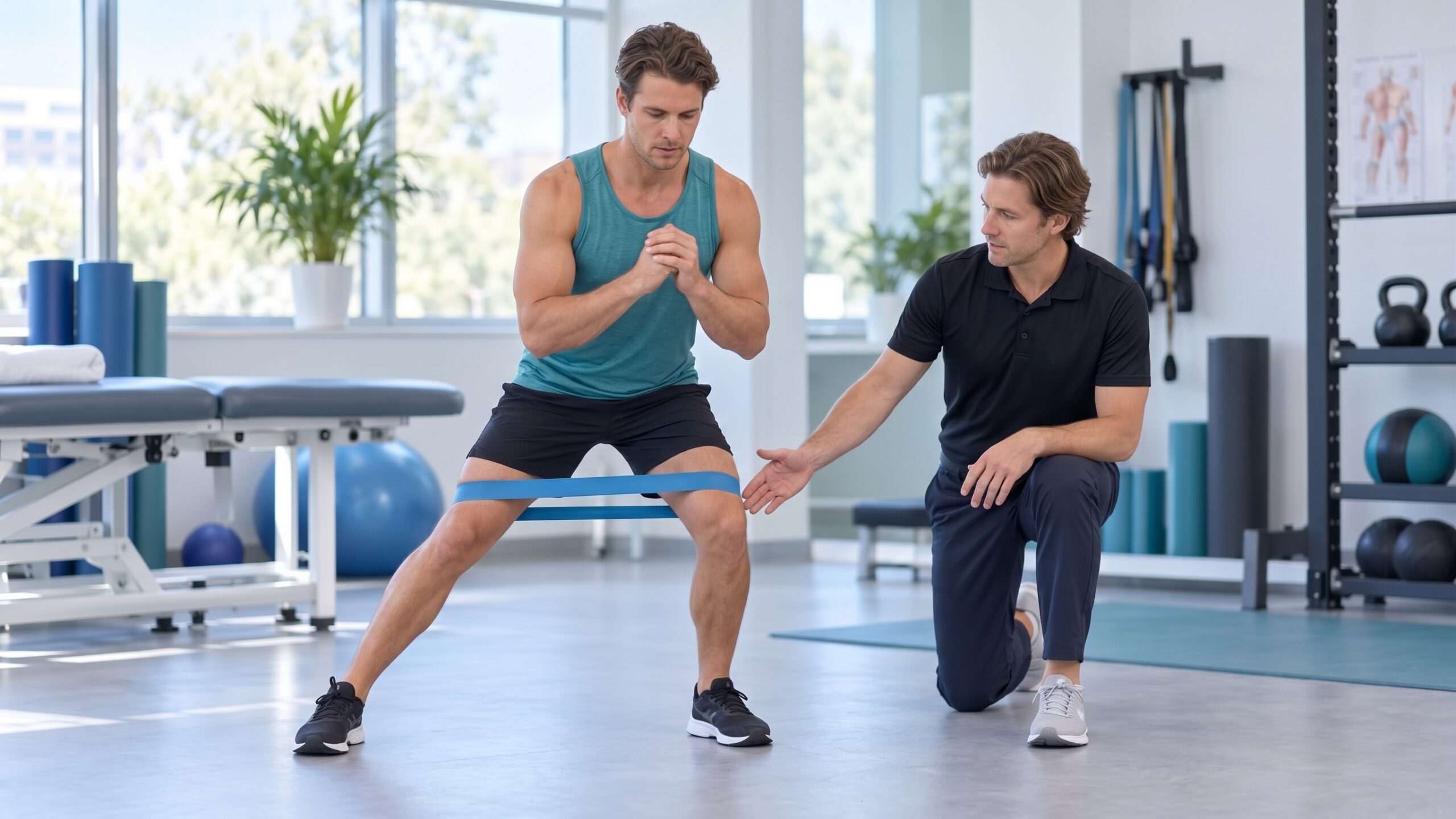
Effective groin pain management is guided by the specific anatomical structure involved rather than generic symptom relief. For muscle and tendon injuries, the primary objective is maintaining active tissue tolerance while avoiding prolonged immobilization, which can weaken the pelvic stabilizers and prolong recovery.
-
Strategic Load Modification: Temporarily reduce or modify high-impact triggers—such as high-speed sprinting, powerful kicking, sharp cutting, and deep lateral lunges—while continuing pain-free daily walking and movement.
-
Acute Symptom Management: Apply wrapped cold packs during the acute phase to calm local discomfort, and consider supportive compression shorts to enhance pelvic and adductor stability during light movement.
-
Safe Pharmacological Guidance: Discuss analgesic or anti-inflammatory options with a physician or pharmacist, particularly if managing underlying medical conditions, and avoid using pain relief simply to mask symptoms during premature sport return.
-
Early Isometric Loading: Begin rehabilitation with low-intensity, pain-limited isometric adductor contractions (such as controlled ball squeezes) to maintain tendon capacity without aggravating the insertion point.
-
Dynamic Strength & Trunk Stability: Progressively introduce full-range adductor loading, core and pelvic control exercises, and single-leg balance drills to build resilience across the entire kinetic chain.
-
Sport-Specific Conditioning: Progress into running, acceleration, deceleration, and multi-directional cutting drills that mirror the exact physical demands of football, padel, running, or combat sports before clearing a full return to play.
Rehabilitation note: Rehabilitation protocols must be dynamically adjusted if clinical testing or imaging reveals co-existing hip joint pathology (such as impingement) or abdominal wall weakness.
Does Groin Pain Require Surgery?
Most adductor strains do not need surgery. Surgery may be considered for selected complete tendon avulsions, confirmed hernias, persistent athletic pubalgia or inguinal disruption, or specific hip-joint conditions that remain limiting after appropriate nonsurgical care. The decision requires a precise diagnosis and a discussion of expected benefits, risks, recovery demands, and sporting goals.
Returning to Sport Safely
A fixed number of days cannot determine readiness. An athlete may feel comfortable walking but still lack the strength and speed tolerance required for competition. Return should be based on progressive criteria and the response during and after training.
| Checkpoint | Practical target before full return |
| Daily function | Walking, stairs and routine movements without a limp or meaningful symptom increase |
| Range of motion | Hip movement adequate for the sport without protective restriction |
| Strength | Adductor, hip and trunk strength restored for the athlete’s demands |
| Running | Jogging, acceleration and faster running progressed without a significant flare |
| Direction change | Cutting, lateral movement and deceleration completed with confidence |
| Sport skills | Kicking, skating, lunging or other relevant skills tolerated at training intensity |
| Next-day response | No important increase in pain, stiffness or loss of function after loading |
Reducing the Risk of Recurrence
Build running, kicking, and change-of-direction volume gradually after a break. Keep adductor, gluteal, hip-flexor, and trunk strength work in the programme rather than stopping when pain settles. Warm-ups should prepare the athlete for the speed and movement of the session. Recovery, fatigue, footwear, playing surface, and previous injury also deserve attention.
For a broader plan covering training progression and recovery habits, read the clinic’s guide on how to prevent sports injuries. Athletes with recurring symptoms can also review the clinic’s sports injury treatment pathway before arranging an assessment.
Get Groin Pain Assessed in Sharjah
Persistent groin pain can reduce running speed, kicking power, and confidence, but guessing the cause may delay the right treatment. Dr. Ahmed Azmy provides orthopedic and sports injury assessment in Sharjah for athletes and active adults across the UAE. Book an appointment for a diagnosis-led recovery and return-to-sport plan.
Medical note: This article provides general educational information and does not replace an examination, diagnosis, or personalised treatment plan.
Dr. Ahmed Azmy Clinic | Orthopedic and Sports Injury Care in Sharjah
Book an appointment now with Dr Ahmed Azmy in Sharjah.