Achilles Tendonitis: Symptoms, Treatment and Safe Return to Activity
The first few steps out of bed feel stiff. The back of your heel aches when you start walking, then seems to...

The first few steps out of bed feel stiff. The back of your heel aches when you start walking, then seems to loosen up. Later, after a run or a game of football, the soreness returns. That pattern can occur with Achilles tendonitis, but pain behind the heel has several possible causes. Knowing exactly where it hurts and how the problem started is the first step toward the right treatment.
The Achilles tendon connects the calf muscles to the heel bone. It helps you rise onto your toes, climb stairs, run and jump. This guide covers common symptoms, the difference between tendon overload and a sudden rupture, and how rehabilitation can support a return to activity. It is written for active adults and athletes in Sharjah and elsewhere in the UAE, whether the problem began during sport or everyday movement. The American Academy of Orthopaedic Surgeons (AAOS) describes Achilles tendinitis as an overuse-related problem and distinguishes it from an acute tendon tear.
What is Achilles tendonitis?
Achilles tendonitis is the common search term for pain and irritation in the Achilles tendon. Clinicians may use Achilles tendinopathy, particularly when symptoms persist and the tendon has not adapted well to repeated loading. The word “tendonitis” does not mean every persistent case is caused by inflammation alone.
Two locations matter because assessment and exercise choices may differ:
| Type | Where pain is usually felt | Why the distinction matters |
|---|---|---|
| Midportion (noninsertional) | Along the tendon a few centimetres above the heel | Loading exercises may be progressed differently from those for pain at the attachment |
| Insertional | At the point where the tendon meets the heel bone | Deep heel drops over a step may aggravate this area and should not be started without appropriate guidance |

You do not need to identify the type yourself. A clinician can assess the exact pain location, tendon response and other possible sources of heel pain. The AAOS specifically cautions against heel-drop exercises over a step for insertional Achilles tendinitis. Read its exercise and treatment guidance.
What are the symptoms of Achilles tendonitis?
Symptoms often build over time rather than beginning with one dramatic incident. They may include:
- stiffness at the back of the ankle when you get up in the morning or after sitting;
- pain along the tendon or at the back of the heel when walking uphill, climbing stairs or running;
- tenderness when you press the tendon, sometimes with localized thickening;
- pain that settles as you warm up but returns after exercise or the next morning;
- irritation where the back of a shoe presses on the heel, particularly with insertional symptoms.
Pain can change as tendon loading increases. Some people keep training because they feel better mid-session, then discover the next day’s first steps are worse. That delayed response is useful information to bring to an assessment. Royal National Orthopaedic Hospital guidance describes morning stiffness, pressure tenderness and pain after activity among common patterns.
A sudden “pop” needs a different response
If you feel a sudden snap or pop behind the ankle, develop sudden weakness, or struggle to push off the foot or rise onto your toes after an injury, stop activity and seek urgent medical assessment. A ruptured Achilles tendon is different from gradual tendinopathy and needs prompt evaluation. Do not try to treat a suspected rupture using a general tendonitis exercise programme. The AAOS describes rupture as a distinct, sudden injury.
Why does Achilles tendon pain happen?
Achilles tendon pain often develops when activity increases faster than the tendon can adapt. Assessment considers the following possible contributors.
- A common trigger is doing more, sooner than the tendon can tolerate: increasing running distance, adding hill sprints, restarting football after a break or raising the number of high-impact sessions.
- A change in shoes or training surface may also contribute.
- Calf strength, ankle movement, health conditions and some medicines can matter too.
- No single factor diagnoses the problem or explains every case.
For people training in Sharjah, a typical history might be a sudden return to outdoor runs after weeks of indoor exercise, or several matches in one weekend after a quieter period. Those examples are reasons to review training load, not proof that the local climate caused the tendon injury. The aim is to identify an adjustable pattern that allows gradual rebuilding, not to assign blame to one workout.
If you have a broader pattern of repeated training-related pain, see the clinic’s guide to overuse injuries and its overview of common sports injuries. This article focuses specifically on the Achilles tendon.
How is Achilles tendonitis diagnosed?
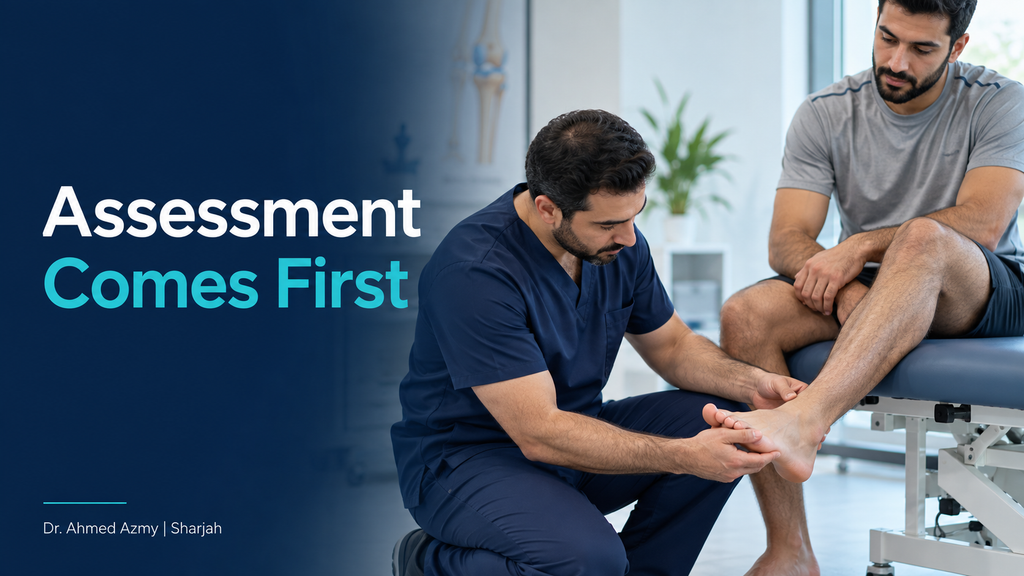
An assessment combines the symptom history with examination of the foot and ankle. Imaging is selected when it answers a specific clinical question.
- An assessment starts with the history: where the pain is, how long it has been present, whether symptoms appeared gradually or after a sudden incident, what training changed and which activities worsen it.
- The clinician then checks tenderness, thickening, ankle movement and the ability to load the calf and tendon.
- They also consider other causes of pain at the back of the heel and assess for a tear when the history suggests one.
- Imaging is not required for every patient.
- Ultrasound or MRI may be useful when the diagnosis is unclear, a tear is suspected or persistent symptoms require further evaluation.
- An X-ray can show certain bone changes near the heel but does not show the tendon in the same way.
- The right test follows the clinical question; an MRI is not automatically the starting point.
Clinical reference: The Royal National Orthopaedic Hospital explains the clinical and imaging approach
Achilles tendonitis treatment: a staged approach
Most people begin with non-surgical care. The treatment plan depends on the location of symptoms, their severity and the demands of daily life or sport.
1. Reduce the activities that flare the tendon
Temporarily cut back on sprinting, jumping or steep running if they repeatedly make pain worse. Lower-impact activity may help you stay active if it is comfortable. Complete inactivity for a prolonged period can make it harder to restore the tendon’s capacity; the goal is an appropriate level of load, guided by symptoms and professional advice.
2. Build calf and tendon capacity
A physiotherapist may introduce calf-strengthening exercises and progress them over time. The programme may change for pain at the heel attachment versus pain higher in the tendon. Do not copy heel-drop routines from a video before you know which type you have. Progress should take account of pain during exercise and how the tendon feels later and the next morning. The Royal National Orthopaedic Hospital advises that exercise selection and progression depend on the individual presentation.
3. Address footwear and symptom relief
Footwear that rubs the back of the heel can aggravate insertional pain. In selected cases, a clinician may suggest a temporary heel lift or another shoe adjustment. Ice may provide short-term comfort. Pain medicine is not suitable for everyone, so ask a qualified clinician or pharmacist before using it, especially if you have other conditions or take regular medication.
4. Review progress before considering further options
If well-planned rehabilitation is not helping, the clinician may revisit the diagnosis, training load and exercise progression. Additional procedures or surgery are considered only for selected persistent cases after a proper assessment; they are not the routine first step. Be cautious about promises of an instant cure. The AAOS outlines non-surgical care and when surgery may be considered.
How long does Achilles tendonitis take to recover?
Recovery depends on symptom duration, the affected part of the tendon and the response to rehabilitation. Restoring running and jumping tolerance often takes several months. The phases below are based on function, not fixed weekly deadlines.
Manage symptoms and walking load
Reduce activities that repeatedly aggravate the tendon while maintaining tolerable movement.
- Modify sprinting, jumping or steep running as advised.
- Review walking tolerance and the next morning’s symptoms.
Rebuild calf strength
A physiotherapist can select and progress exercises for the affected tendon location.
- Build calf strength at an appropriate load.
- Avoid copying deep heel-drop exercises for insertional symptoms without professional guidance.

Introduce higher loads
Progress beyond basic strengthening when the tendon tolerates it.
- Introduce controlled higher-load tasks under guidance.
- Adjust progression if symptoms worsen later or the next morning.
Return to running or sport
Gradually restore the specific demands of the intended activity.
- Build running volume or sport-specific drills in manageable steps.
- For football, assess repeated acceleration and changes of direction.
New sudden weakness or a pop needs prompt assessment for a possible tear. Persistent symptoms should be reassessed rather than forced through a timetable.
Related guidance: Royal National Orthopaedic Hospital notes that conservative recovery may take months or longer
Achilles tendon pain in sports
Running, jumping and repeated acceleration load the Achilles tendon. Returning to football after a break or suddenly adding running distance can increase demands before the tendon has adapted. A sports injury assessment considers the exact pain location, training changes and whether symptoms suggest gradual overload or a sudden injury.
Explore the clinic’s sports injury services for information about arranging an assessment in Sharjah.

When should you see an orthopedic specialist in Sharjah?
Recurring heel or tendon pain deserves assessment when it affects daily life or training. Use the following signs to decide how promptly to seek help.
- Arrange a consultation if pain keeps returning or limits walking or training.
- Book an assessment if symptoms worsen despite reducing aggravating activity.
- Seek an assessment if you are unsure whether the problem is tendonitis or another injury.
- Seek urgent assessment after a sudden pop with marked loss of push-off strength.
Dr. Ahmed Azmy’s clinic in Sharjah provides orthopedic and sports-injury assessments. An appointment can establish the likely cause and identify the appropriate care pathway or referral if your symptoms require a service beyond the clinic’s scope. Explore the clinic’s sports injury services or contact the team to arrange an evaluation.
Ready to return to activity with a clearer plan? Tell the clinic where the pain is, when it started and how it responds to exercise. That information makes the first assessment more useful.
Frequently asked questions
1. Is Achilles tendonitis the same as Achilles tendinopathy?
The terms are often used together. “Tendinopathy” is frequently preferred for longer-lasting tendon pain where changes are more complex than a brief inflammatory episode.
2. Where does Achilles tendonitis hurt?
Pain can be along the tendon above the heel or at its attachment on the back of the heel. The exact location affects assessment and rehabilitation choices.
3. Can I keep running with Achilles tendonitis?
It depends on symptom severity and how the tendon responds later and the next morning. You may need to reduce or temporarily replace running while progressing a tailored strengthening plan.
4. Why is my Achilles tendon stiff in the morning?
Morning stiffness is a common pattern with Achilles tendinopathy. A clinician can confirm whether your symptoms fit and check for another cause if needed.
5. Do I need an MRI for Achilles tendonitis?
Not always. A history and examination often guide diagnosis. Imaging is considered when it will answer a specific question, such as an uncertain diagnosis or possible tear.
6. Are heel drops suitable for everyone?
No. The type and depth of exercise should reflect whether pain is in the midportion of the tendon or at the heel attachment. Heel drops over a step may aggravate insertional symptoms.
7. Will Achilles tendonitis go away without surgery?
Many people improve with activity adjustments and a progressive rehabilitation programme, although recovery can take months. Surgery is reserved for selected persistent cases after evaluation.
8. When is Achilles pain an emergency?
A sudden pop with immediate weakness or difficulty pushing off the foot may signal a rupture. Stop sport and seek urgent medical assessment.